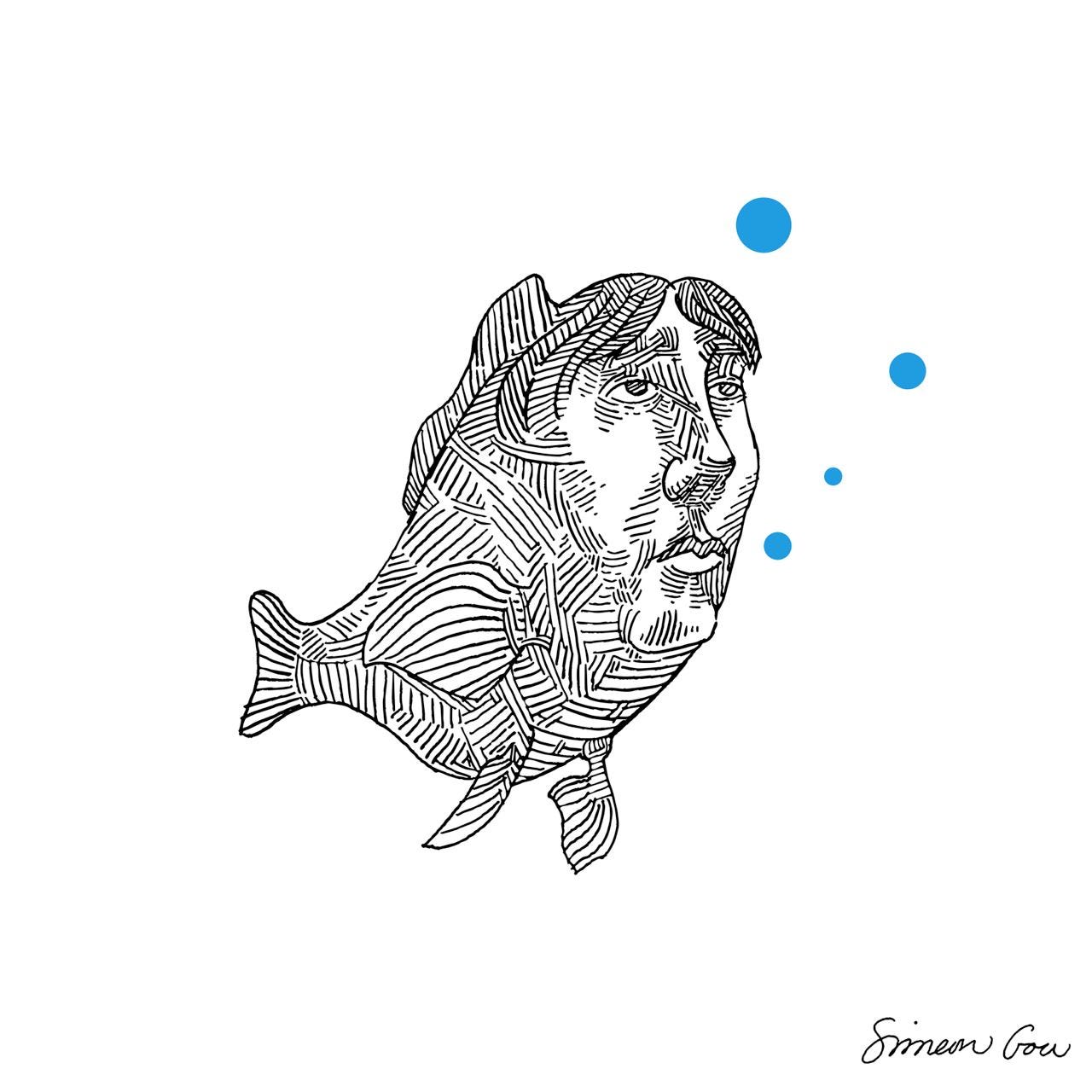
Considered Form XXII -- On Peter Cook’s Sven from Swiss Cottage; On Categories of Identity, Currents of Integrity
October, 2022

by Andrew Bingham, with Simeon Goa (simeongoa.com)
— online version: www.consideredform.substack.com —
On Peter Cook’s Sven from Swiss Cottage
Peter Cook is never not funny, not because of any kind of special effort, just because … his whole instinct is of a consummate wit … and he knows the untenable idleness of genius whose refuge is play. Despite his keen poise in public, Cook’s humour is often of a gentle lunacy, of a quiet brilliance which tends towards a sincerity of tone leading towards merriment — he is found playing with the edges and ends of sincere plausibility, partaking of the dance of ‘la voix et la voie’, à la Robert Bresson, albeit in a different emotional register. Sven from Swiss Cottage, Cook’s persona which may be heard on the compilation Over at Rainbow’s or via videos online, is a gentle parody of the conventions of public conversation, topics, and relations — over the course of several initially anonymous calls to a late-night radio show, mostly circling around tales of his native Norway and his errant wife Jutte, all comprehended in terms of an emphasis on fish. And so we hear a master of the calm, stately absurd partaking of the delight born of sustaining one’s fantasia over time, the enjoyment of sharing with others one’s private sources of amusement.
Sven is a product of an insomniac intelligence … one with a love for humour in itself, not merely for a certain, adoring audience, the kind of mind which finds itself occupied in the wee hours with sending faxes to world leaders with advice on how to conduct themselves in international relations, etc. In these humorous night wanderings, we find Cook meandering through his invented world of Sven to an inevitably funny punchline — a method later used and slightly differently employed by Norm Macdonald with equal genius — and in the process, enjoying the delicious moment when one realises all is merrily askew, yet not wildly askew. Thus Sven points to Norwegian culture: ‘we have Fish Hour on the radio’; he demonstrates his keen perception: ‘is it Jutte with a fish?’, in response to an aural clue contest; and he reassures his listeners of how much fun children have during Fish Hour when the topic is gefilte fish, with questions like: ‘…and how many times can you spell that?’
****

****
On Categories of Identity, Currents of Integrity
Category, a first movement of analysis in philosophy, becomes in Aristotle a centre of clarity and distinction; the activity of distinguishing is essential for Aristotle, yet not for itself, not in order to bestill life in a series of separations ad infinitum — the lesson of Zeno’s thought-fancies. Aristotle’s focus on discernment is not its own cul-de-sac — he distinguishes things in light of and for the sake of a larger truth or event, in order to conjoin anew. In this thinking, elements belong together and to an ultimate … some kind of overarching, determining telos for which one strives. This type of movement depends on one conceiving language as gestural in essence, as the phrasing of meaning itself, and not considering language as culminating in naming or in identification. To confine language to naming or identification is to make ‘idem’, ‘sameness’, the determining category, which manifests itself as bestilled life — dead water, not Cézanne’s glorious apple. For identity reduces something vital and complex to a still point, which in our time and others is often a borrowed idea, someone else’s conception — thus the farce of one becoming ‘oneself’ by imitating others closely — and this act of identification often distinguishes in order to separate further, to individuate and individualise, albeit it via assumed imitation.
If the question of identity involves living via concepts rather that living through relation and participation, the question of relating well and participating wholeheartedly, which belong to the method of composition, finds its end in the ongoing movement of integration, in the energy of integrity. The energy of integrity means, involves, and is informed by the calm coherence of a composed countenance; the formative movement — the current — of integrity seeks appropriate form: a line, rhythm, and tonality that one may call one’s own. Thus integrity becomes of a countenance composed with appropriate form, the currents of which — like currents of water, of electricity, of thought, of wind — are always in movement, perpetually moving, and never inert, never ‘of inertia’. And as currents blend, inwardly form each other, and coalesce as in a river or the wind, so coalescence is of the integral essence: the drawing near of all as or in one harmony, the way in which one draws together all of one’s aspects into one’s own character, the unique flow of being proper to one’s own ethos. Yet as THE WIND, which causes so many bruises when it buffets us, is harnessed by the careful integrity of the panpipe, melody ensues.
****
'...that lets you flow like you flow...'
~Cutty, to Avon Barksdale, The Wire.
****